
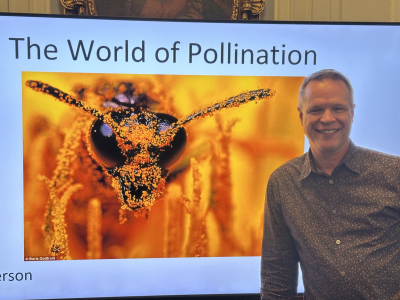
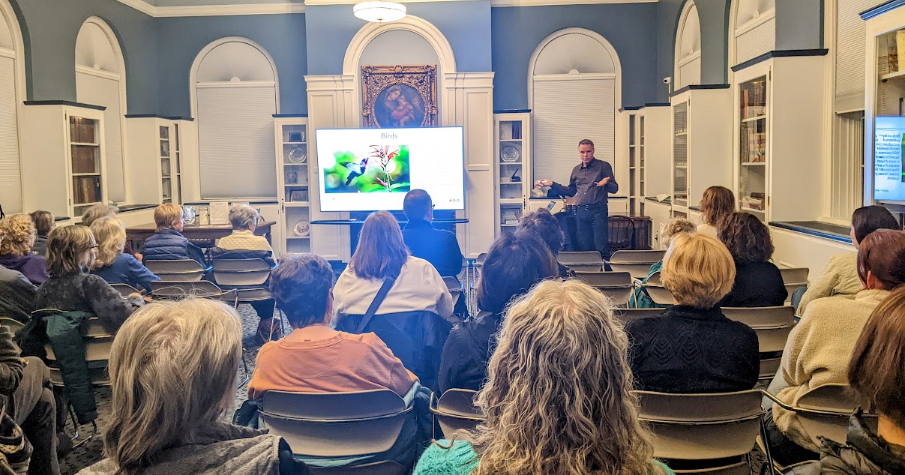
Last week, the Hartland Home and Garden Club hosted local non-profit, Bees in the D, in the Community Room to discuss pollinators of the world! Bees in the D hosts more than two hundred beehives at more than seventy locations in the Metro Detroit area, educating and advocating for pollinators while also producing local honey to benefit their cause. Some hives are in the city, and others are hosted at local farms and vineyards. Interestingly, there is a greater diversity of plants in cityscapes than rural areas like farmlands, which tend to host a monoculture of plants that all bloom at once and carry a smaller diversity of nutrients for the bees.
We may think of honeybees as the typical local bee, but bees are an incredibly diverse group of insect. In fact, there are more than 450 bee species in Michigan besides honeybees! An often overlooked fact about honeybees is that, while they are tremendously beneficial in our ecosystem, they are not native to North America. They are comparable to livestock, in the sense that their population is managed by humans on a large scale. Without honeybees on our continent pollinating crops, our food system would crash. Air pollution and changes in resources have already affected food production by reducing pollinator populations in some parts of the world, and the effects of this loss are significant. It's more important now than ever to protect our pollinators of every kind.
During his presentation, Brian took us on a journey around the world to explore some of the lesser-known pollinators of the mountains, the tropics, and high in the tree canopy. We learned about wasps, monarch butterflies, lizards, and other creatures that enjoy mutually beneficial relationships with specific plant species. Even some mammals, like bats, honey possums, and sugar gliders pollinate plants!
For those of us who love figs, we can thank the sacrifice of the female gall wasp for our fruit. While the fig fruit is underdeveloped, gall wasps crawl into a very narrow opening in the immature fig, where the flower is located. During this process, the wasp loses her wings and legs, and dies inside the fig. She pollinates the flower when she reaches it, and the figs swell and become ripe fruit. But don't worry-- the wasp is broken down inside the fig, so you're not going to find a fully formed wasp inside your fruit.
Fans of the beautiful monarch butterfly will already know that monarchs travel incredible distances each spring and fall, as a part of their life cycle. But did you know that typical monarch butterflies only live for about 2-6 weeks during the summer breeding season? Their amazing spring migration takes multiple generations, leapfrogging from Mexico to the United States. There are supergenerations of monarchs that are created during the summer: they are physically larger and can fly farther than their typical counterparts, and in the fall they can travel all the way back to Mexico -- where their great, great, great, great grandmothers once lived -- in one trip! They spend the winter in Mexico, and in the spring the migration process begins again.
There is so much to love about the pollinators of the world! From the incredible species thousands of miles away to our favorite bee and butterfly species here at home, Brian's presentation emphasized the importance of caring for our pollinator populations.
Pollinators from all over the world teach us so much about the incredible capabilities of nature, but they also remind us of the fragility of our ecosystems. With symbiotic relationships formed by co-evolution, like that between pollinator and plant, eliminating one aspect of nature can cause an enormous chain reaction of loss. We need certain plants to keep our amazing pollinators alive, and vice versa!
There's so much we can do in our communities, and even in our own backyards, to support local pollinators. Safe gardening practices, such as the reduction of pesticides and planting varieties of plants instead of monocultures, can help keep our local bees, hummingbirds, butterflies, and other pollinators well fed. Bees especially love flowers from herb plants, so even if your gardening space is small, adding a few potted herb plants can make a tremendous difference! Perhaps the best thing we can do to support our pollinators over the growing season is to plant native wildflowers, which have symbiotic relationships with many of our native bees. See the 2026 Native Plant Sale Pre-Order Form to peruse native flowers, like milkweed, black-eyed Susans, great blue lobelia, goldenrod, spiderwort, wild petunia, and more!
When planning your garden, keep in mind that bees also need water! They can struggle to find hydration in the hot, dry summer months. Making a water bath for pollinators, complete with marbles, wine corks, or other small items in the water to keep bees from drowning, can help them in the summer.
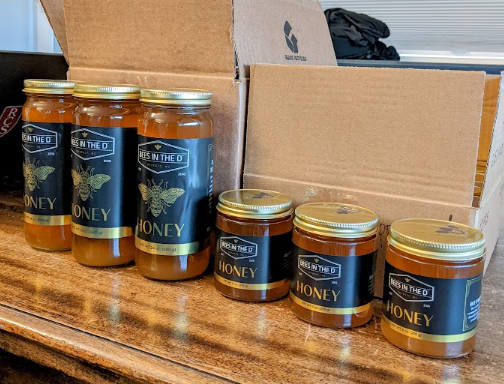
Bees in the D does amazing work to support Michigan pollinators, and they also offer opportunities for education. You can take honey tasting and sommelier classes, beekeeping introduction classes, and engage with volunteer opportunities. Their honey is all produced and packaged locally, and each jar features a specific code referring to the exact location where the honey was produced in the Metro Detroit area. If you'd like to try some of this lovely honey, you can buy a jar online!
We hope to see you at more gardening programs at the Library soon. This month, we're looking forward to our Spring Seed Swap on Saturday, March 28 @ 11:00 am. Whether you have seeds to share or not, please visit the Community Room on the third floor to chat with other gardeners and to find some new seeds for your garden!
We are just weeks away from the first day of spring. We wish you a restful and energizing farewell to winter, as we prepare for exciting events during the growing season!